You can own a good rod, choose a sensible fly and make a serviceable cast. If your fly passes through water where no trout is holding, however, you may wait a long time for a take. Reading trout watermeans identifying places where the current delivers food without forcing a fish to spend all its energy fighting the flow.
A river is not one uniform ribbon. It is a sequence of riffles, runs, pools, soft edges, boulders, roots and depth changes. Each feature alters the speed of the water and can create a place where a trout feeds or rests.
The encouraging part is that you do not need to see the fish. Begin by seeing why a trout would choose one place over another.
Look for three things before you cast
A river trout must solve three problems: find food, conserve energy and avoid danger.
- Food is often delivered by the current in the form of aquatic insects, terrestrial insects, larvae and small fish.
- Relief comes from slightly slower water beside an obstruction, close to the bottom or along an edge.
- Cover may be provided by depth, shade, a large boulder, an undercut bank, roots or woody debris.
The most useful holding water often combines all three. A trout can remain in softer water while watching a faster lane carry food past its position.
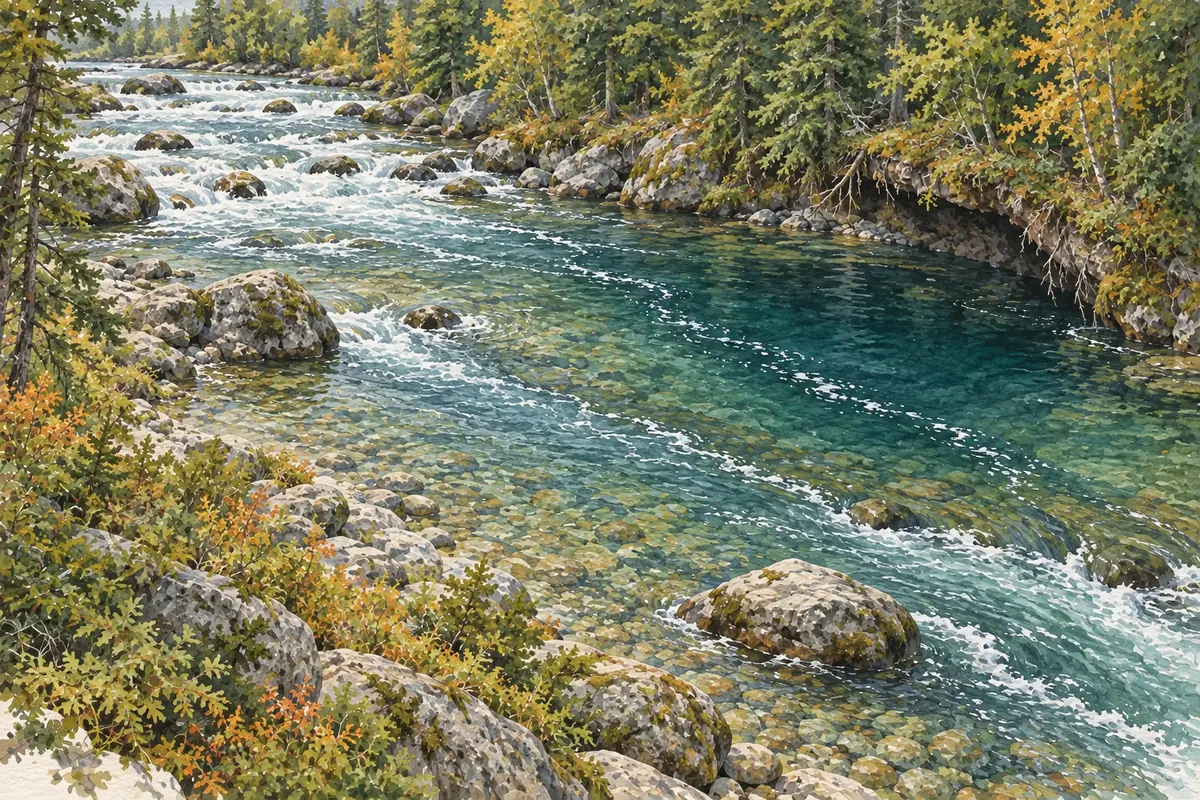
Stay on the bank for two minutes before stepping into the water. Watch the surface, bubble lines, dark areas, obstructions and insect activity. You will usually see more from shore than you will once you are standing in the middle of the river.
Seven places to cast your fly
Trout may change positions with the time of day, water temperature, flow and available food. The following seven places do not guarantee a fish, but they will keep you from casting blindly across the entire river.
1. The seam between fast and slow water
A current seam , or current line, is the boundary between two water speeds. It may appear as a change in surface texture, a line of bubbles or a visible division between fast and soft water.
A trout often holds on the slower side and moves a short distance to intercept food drifting in the faster lane. Cast far enough upstream to let the fly reach the proper depth. Try to drift along the boundary instead of dragging the fly sharply across both currents.
2. The head of a pool
The head is where a riffle or run pours into deeper water. Flow concentrates food there, while the change in depth gives trout cover.
Begin along the shoulders of the incoming current, then explore the main tongue. A fly that lands at the top of the pool may need several feet or metres of drift before it reaches the fish’s depth.
3. A run and its bubble line
A run is deeper than a riffle and carries steady current, often beneath a relatively smooth surface. Beginners sometimes overlook runs because they appear featureless.
Look for a bubble line, a slight colour change or a lane in which natural debris follows the same path. That line often reveals the food conveyor. Fish it with a series of short drifts, beginning close to you and gradually working farther out.
4. The front, sides and back of a boulder
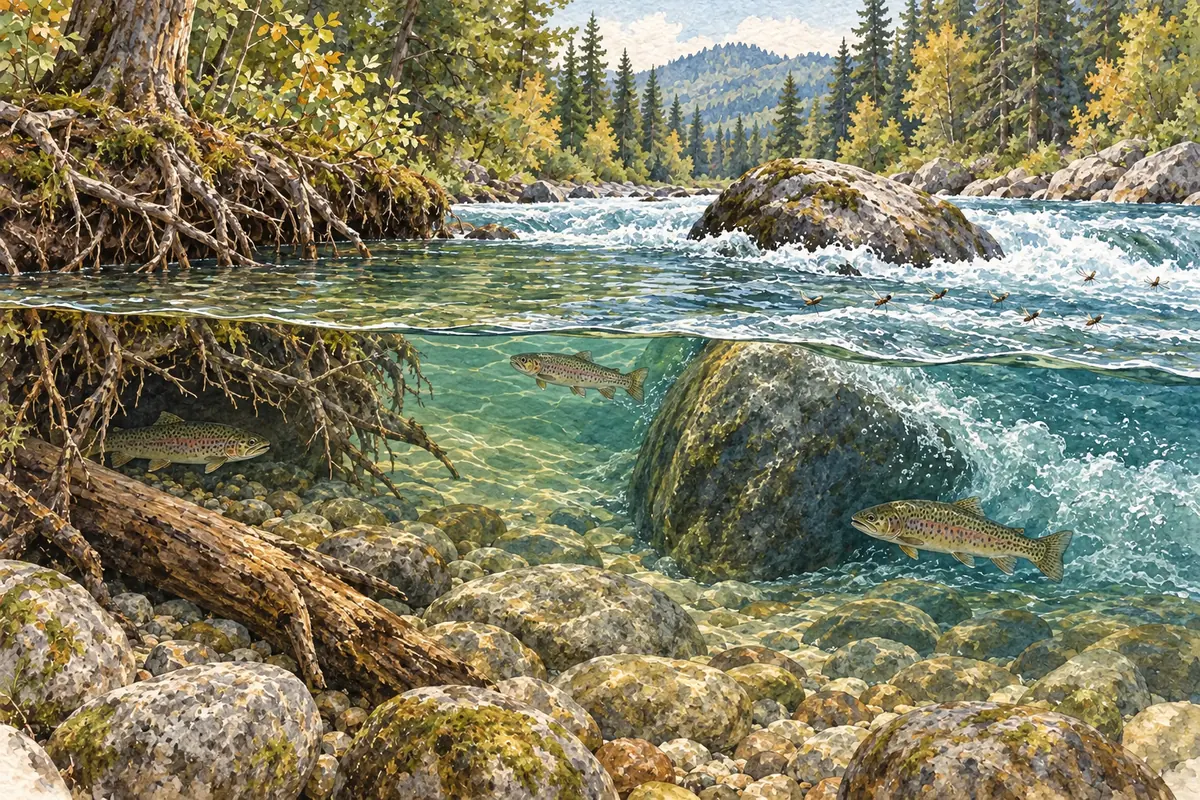
A boulder splits the flow and creates several softer areas. A trout may hold in the cushion of water in front of the rock, along either side or in the downstream pocket. Do not assume every fish will sit directly behind the boulder.
Cast far enough upstream to let the fly approach the protected area naturally. Work one side and then the other before covering the centre of the pocket. Avoid dropping the fly line directly over the holding water on your first cast.
5. The tail of a pool
The tail is where a pool gradually becomes shallower before the next riffle. Food may concentrate there, but the thinner water makes trout especially alert.
Approach from downstream when the terrain allows, keep a low profile and limit false casts. Fish the near edge first. A trout may be much closer to your feet than you expect.
6. Undercut banks, roots and woody cover
A shaded bank, root system or fallen tree can offer cover, depth and food in one place. These spots may hold good fish, but they also increase the chance of snagging.
Present the fly near the cover without throwing straight into it on the first attempt. Start along the outside edge and move closer. Never step beneath an unstable bank or cross dangerous current merely to recover a fly.
7. Depth changes and bends
A shift from light to dark water may reveal a drop-off or deeper slot. On a bend, the outside is often deeper and more structured, while the inside may provide softer water. The best position changes with the flow, so look for the place that combines relief with a nearby food lane.
Use a fan of casts to explore several depths. If you cannot see the bottom, move carefully; a simple colour change can hide a steep ledge.
A good drift often matters more than the exact fly pattern
Finding the right holding water is only half the task. Your fly still needs to pass through it convincingly.
A dead-drifted dry fly or nymph should generally travel at about the same speed as nearby bubbles. If line in faster water begins to pull the fly out of its lane, lift and reposition a section of line upstream with a gentle mend , or line correction.
When nothing responds, work through the problem in this order:
- confirm that the fly is actually passing through likely holding water;
- improve the drift and reduce unwanted line tension;
- adjust the depth;
- then change the fly size or type.
Changing flies after every cast mostly creates confusion. A short series of controlled drifts teaches you much more.
Approach without warning the trout
Good water reading can be undone in seconds by a careless approach.
- Observe from shore before standing above the water.
- Fish the close water before stepping into it.
- Move slowly to avoid wakes and grinding rocks.
- Use vegetation and boulders to break up your outline.
- In clear current, approach from downstream when possible and keep your shadow away from the holding water.
- Limit false casting, which can alert fish and catch streamside vegetation.
Trout do not always face the same direction, especially in eddies, but they readily detect sudden movement, vibration and shadows.
Flow and temperature can redraw the map
The same river will not read identically every day.
High or stained water
Strong flow often pushes fish toward banks, side channels, pockets behind obstructions and other soft water. Do not rush into the middle. Check access, streamflow and local warnings before wading.
Low and very clear water
Trout may favour depth, shade and lower-light periods. A discreet approach, short accurate casts and a drag-free drift become more important than distance.
Warm water
Trout depend on cool, oxygen-rich water. During hot weather, favour cooler periods, follow local restrictions and stop fishing when conditions make safe recovery doubtful. The fish’s wellbeing matters more than one additional catch.
In lakes and reservoirs, look for edges too
Still water can appear featureless, but trout are not spread evenly across an entire lake.
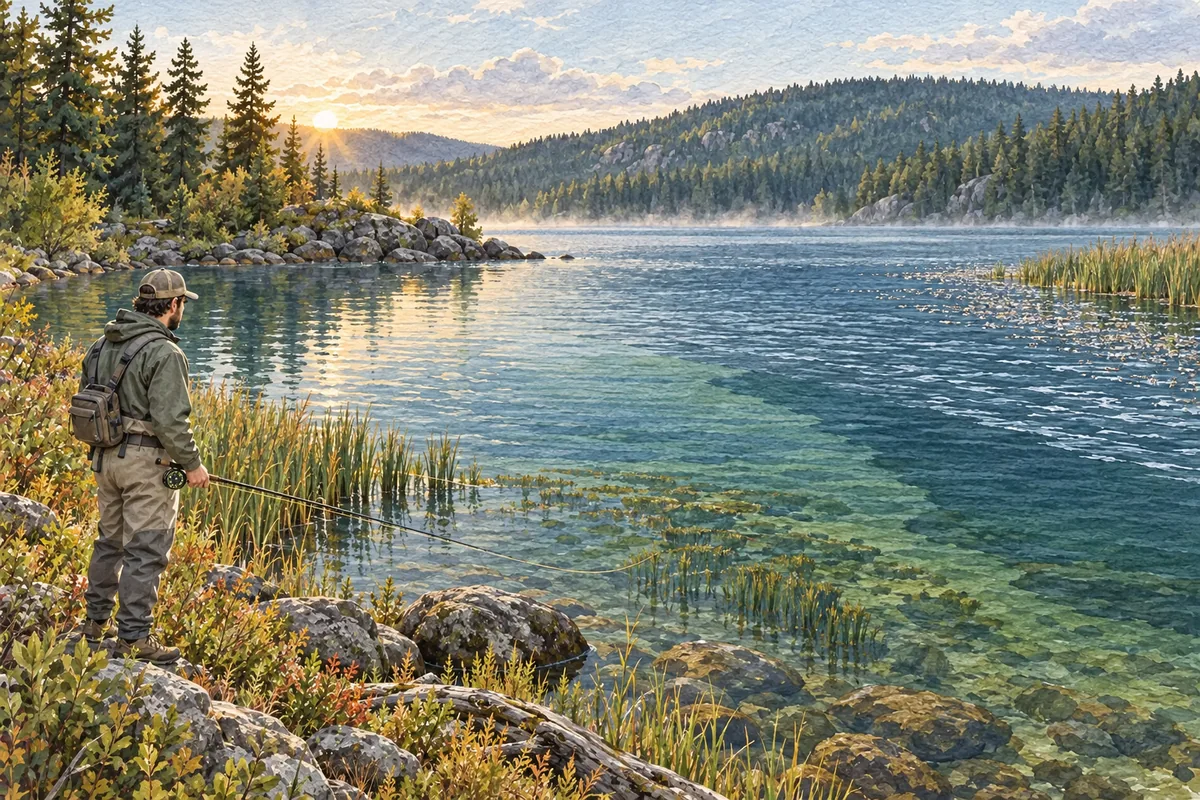
From shore, watch for:
- the outside edge of a weed bed;
- a rocky point continuing below the surface;
- an inlet or outlet;
- a colour change that reveals a drop-off;
- a bank toward which wind is pushing insects;
- rising fish, birds or moving baitfish.
Trout may move into shallow margins during the morning and evening. As the surface warms, they may drop deeper or gather near cooler inflowing water. Do not wade into a lake immediately. Prospect the water close to your feet first.
A simple plan for the first ten minutes
Try this routine at your next piece of water:
- Stand back and observe for two minutes.
- Find soft water beside a food-carrying current and nearby cover.
- Select only two or three targets.
- Fish the near edge before the far bank.
- Make three controlled drifts through each target.
- Correct the drift, then the depth, before changing flies.
- Record the location, apparent flow, depth and result.
This process turns an intimidating river into a short series of observable decisions.
Do not cast everywhere; cast for a reason
Reading water does not mean knowing the exact location of every trout. It means narrowing the possibilities by looking for the best balance of food, current relief and cover.
Begin with current seams, the heads and tails of pools, boulders, banks and depth changes. Fish close first, watch the drift and use every take—or lack of one—as information.
If you are still planning your first days on the water, read How to Fly Fish: A Beginner’s Guide to Your First Outing. If you are choosing tackle, see How to Choose Your First Fly Rod. Progress comes from observing a little more clearly on every outing, not from trying to cover the whole river on your first day.
Keep exploring this world
Streamer Fishing for Trout: How to Work Your Fly
Learn three simple streamer retrieves, control depth and line contact, and decide what to change when a trout follows without biting.
Read the article
Nymph Fishing: How to Find the Right Depth
Understand indicators, weight and sinking time, then use simple comparisons to find a suitable nymph depth in a river.
Read the article
Fly Fishing Roll Cast: How to Fish with Trees Behind You
Learn to cast with limited space behind you: anchor, D-loop, five practical steps, common mistakes and a ten-minute practice session.
Read the article