The question of rooster and laying comes up often when you start keeping a few hens at home. Many people think a rooster is essential to get eggs, when in reality a hen can lay without a rooster. The rooster's role is mainly linked to reproduction, to fertilising the eggs and to the social balance of the group.
Understanding this difference helps you make better decisions before adding a rooster to the henhouse. It's very useful information when you want to learn to run a small flock simply, without complicating your life or taking in an animal whose needs you don't know well. It also helps you build a calmer, more natural routine that better suits your space.
Rooster and laying: does a hen need a rooster to lay?
No, a hen doesn't need a rooster to lay. Laying is a natural process of the hen's body. As long as she is of laying age, gets good food, enough light and lives in a safe environment, she can produce eggs without a rooster present.
The rooster only becomes necessary if you want fertilised eggs to hatch chicks. Without a rooster, the eggs will never produce chicks, but they remain perfectly edible. This is in fact the most common situation in small family flocks: many people keep only laying hens to gather fresh eggs, without introducing a rooster.
This distinction matters, because it avoids adding an animal needlessly. A rooster can be noisy, territorial and sometimes hard to manage depending on his temperament. If your goal is simply to have eggs for cooking, your hens can fill that role perfectly well on their own.
Rooster and laying: does a rooster increase how much hens lay?
A rooster doesn't directly increase how much hens lay. He doesn't stimulate egg production the way better food, good light or a less stressful environment would. The number of eggs depends mainly on the breed, the hen's age, the season, general health, the length of the day and the quality of the food.
This association of rooster and laying often creates confusion, because two different things get mixed up: laying and breeding. The hen lays eggs with or without a rooster. The rooster only makes it possible for some eggs to be fertilised.
To improve production, it's better to act on the real levers: offer a complete feed for laying hens, give access to clean water, provide free-choice calcium, keep the nest boxes clean and reduce stress in the henhouse. These simple steps often give better results than adding a rooster to the group.
The rooster's role in a group of hens?
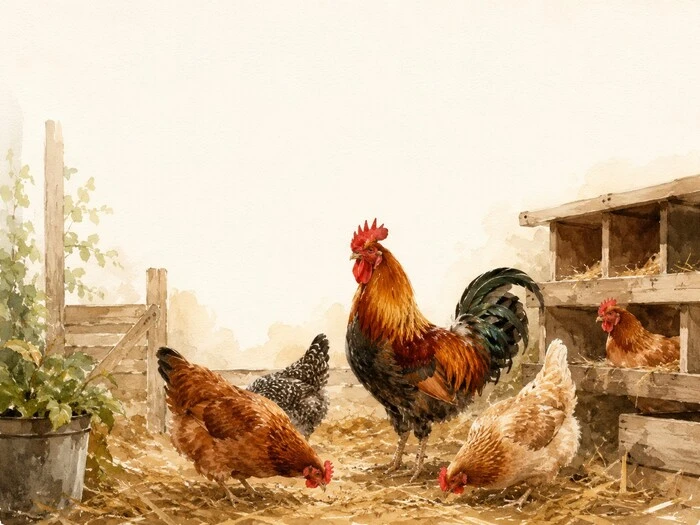
The rooster can play a social role in a group of hens. He watches the environment, sometimes warns the group of danger and can guide the hens towards food. In some henhouses, he also helps maintain a certain hierarchy.
However, this role depends a lot on the rooster's character. Some are calm, protective and well integrated. Others can become aggressive with people or too insistent with the hens. An overly dominant rooster can stress the group, damage the hens' feathers or create tension in the henhouse.
So before taking one in, you should ask whether there's enough space, whether the neighbours accept the rooster's crowing and whether the group of hens is big enough. In a very small group, a rooster can sometimes wear out the same hens over and over. For a simple, peaceful flock, he isn't always the best choice.
Are hens happier with a rooster?
Hens aren't automatically happier with a rooster. They can live very well among themselves, without a male, as long as their essential needs are met. A clean henhouse, a safe outdoor space, comfortable nest boxes, a balanced diet and a stable routine have far more impact on their daily wellbeing.
A good rooster can bring some structure to the group, but he isn't essential to the hens' happiness. What matters most is the quality of the environment. Hens that scratch the ground, take dust baths, eat properly and rest without stress are generally hens that are well suited to their surroundings.
For someone looking to get closer to nature while keeping life simple, this is reassuring. You can start with just a few hens, without having to deal with the constraints of a rooster.
When should you really consider getting a rooster?
It can be worthwhile to have a rooster if you want to breed, get fertilised eggs or let a hen brood chicks. In that case, the rooster has a clear and useful function.
He can also be appreciated in a large rural space, when the noise bothers no one and the hens have enough room. In a calm environment, with a balanced rooster and a good hen-to-rooster ratio, his presence can become harmonious.
But if your priority is simply to have fresh eggs for the home, the rooster-and-laying question is easily settled: the rooster isn't necessary. You can have a productive, pleasant and easy-to-manage small flock with hens alone. rooster and laying se résume facilement : le coq n’est pas nécessaire. Vous pouvez avoir un petit élevage productif, agréable et facile à gérer avec des poules seulement.
How to encourage good laying without a rooster?
To encourage good laying, start by offering feed suited to laying hens. They need protein, minerals, calcium and fresh water every day. Calcium is essential to form strong shells, while light strongly influences the laying cycle.
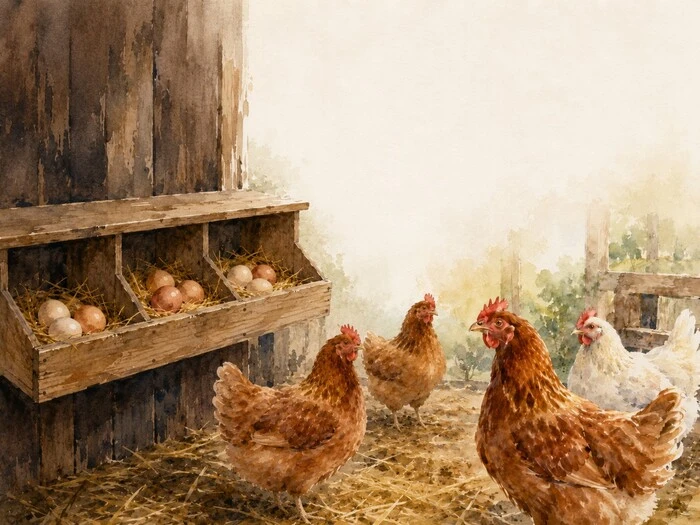
A good nest box also plays an important role. It should be clean, quiet, dry and slightly dark. Hens like to lay in a place where they feel safe. If the nest box is dirty, too exposed or disturbed, some hens may lay less or lay elsewhere.
Consistency helps a lot. A simple routine, care that's easy to repeat and daily observation make it easy to spot small changes quickly: a drop in laying, fragile shells, unusual behaviour or stress in the group.
Conclusion
Le lien rooster and laying est souvent mal compris. Une poule n’a pas besoin d’un coq pour pondre des œufs. Le coq sert surtout à féconder les œufs et à participer à la dynamique du groupe, mais il n’augmente pas directement la production. Pour avoir de bons œufs, il vaut mieux miser sur l’alimentation, la lumière, la propreté du poulailler, le calme et le bien-être des poules.
By understanding this role, you can make a simpler, more informed choice. You avoid needless complications while creating a small flock that's more natural, practical and pleasant day to day.
And you, do you prefer to keep only hens for fresh eggs, or would you also like to have a rooster in your henhouse?